Appologies, first of all, for the enormous delay. I am once again writing from an internet cafe because I still have not gotten a working connection in my appartment (I've been a little too busy and a little to lazy to deal with that). Therefore, the pictures I took to go along with this will have to wait.
Shengda has a student body of about 15,000 crammed into a campus about twice the size of Swarthmore. This creates an enormous problem of control that must be very familiar to the Chinese, given the enormous population of pretty much the entire Eastern Seaboard of the country. I knew that it would be like this, coming here, but it is nevertheless amazing to see the vast groups in person. And it is even more amazing to see the ways in which they are controlled.
Every morning at 6 o'clock, the students are woken up by a broadcast on the PA. They are essentially kicked out of their dorms, at which point they procede en masse to the cafeterias. They have a chance to go back to their dorms to wash up afterword, untill they are locked out untill about 1 o'clock in the afternoon. Then, they get an hour and a half for a nap before being kicked out of the dorms again until after dinner. Finally, they must all be in by 10:30, when the gates are locked, with concequenses for any students caught outside. They are only allowed off campus on the weekends or with special permissions or if they are with a teacher.
The rules do not end here, however. Students are not allowed to bring any books into the library. The reason stated is that this makes it clear if they are trying to steal a library book. The actual reason is that the library is way too small for all the students to study in it's relative comfort. It is about the size of the main Swarthmore library (McCabe). Keep in mind that Swarthmore also has a separate Science library almost as big as McCabe, as well as smaller libraries in the music building, the women's resource center, the black cultural center, the educational materials center, and probably some other centers that I never went to. For 1/10th the population of Shengda! Instead, the students have to study in their classrooms.
The library is undersized largely (pardon the pun) because it was designed with a smaller student body in mind. Remember that Shengda is a for-profit college, so it is constantly expanding its enrollment in an attempt to make more money. The library is not the only resource that is squeezed. The cafeterias are completely mad during lunch-time. In fact, this has reached the point where the students are not allowed to use one of the cafeterias during certain periods so that the teachers and staff are assured the possibility of getting a seat. The impact of all of these rules is enormous.
First of all, the students all seem to internalize the rules to an astounding degree. The main road through campus is a mob scene starting about 1/2 hour before classes in the morning, for most of lunch hour, and starting about 1/2 hour before classes in the evening. It is almost completely deserted during the rest of the day. This is despite the fact that some of the student are not in class during this time. In the evening at about 9 o'clock, it is a mob scene again, althogh I'm not really sure why. The massing of students at lunch time and such is not that surprising. The same pattern can be seen at Swarthmore. What is strange is that there is almost never a medium amount of students hanging out, walking leasurely along; the streets are either packed or almost deserted. And you will never find students waiting to have a slightly later lunch. Even though the cafeterias tend to clear out a bit around 12:30, they go from packed to empty; there are no students coming in half an hour late to avoid the worst of the crowds. When I decided to hold my English corner at 1 o'clock, the students were mystified. 1 o'clock is their nap time, and it was totally foreign to consider doing anything else then.
The student mob plays a major role in the order of the community in LongHu Village as well. Because the students are not allowed out during the week, business on the nearby streets is a moderate trickle. There are maybe six or eight street vendors out and small groups of locals in the conveniance stores and restaurants. Starting Friday afternoon, the students descend onto the streets, and a croud of small businesses take up residence to meet their demand. Six street vendors becomes thirty. They sell sandwiches and wraps of various types, skewers of lamb, chicken, eggs and vegetables, skewers of fruit, skewers of fruit dipped in syrup, peanuts, sunflower seeds, fried noodles, fried rice, cold noodles, cold rice noodles, stinky tofu... Four fruit carts becomes twenty, selling apples, pears, plums, little apple-like fruit, kiwis, grapes, oranges, melon... Other carts appear selling tea, crackers (by the half-kilo), house plants, goldfish. Other vendors set up blankets on the ground, selling big thermoses, water bottles, toilet paper, bowls, towels, shoes, trinkets, magazines, socks, basins for doing laundry, soap, basketball jerseys (this last rack, in fact, operated by a student, a friend of mine from the basketball courts). Suddenly, busses cannot pass, people dismount their bicycles, etc. The population of the street probably increases one-hundred-fold for these three days.
The community is institutionalized to an enormous degree that can be a little depressing in class. Individualism and creativity are not traditionally celebrated virtues in China. Given the mob-like behaviour of the students around campus, I can hardly be surprised that they don't like to speak out when they know something, let alone when they don't. They are unhappy to write about anything remotely political that requires thought as opposed to regurgitation. Threre are, of course, exceptions, but on the whole, Shengda is doing an amazing job preparing these mindless drones of students to be mindless drones of businessmen.
Sunday, September 11

Monday, August 29
Wheeling, and Dealing
Wheeling
I bought a bike a couple days ago. This was an adventure on a much higher level than shopping ever is in America. I decided that I wanted to buy a used bike, because that way I would get more bike for the money (so long as I checked it out carefully) and the bike would pose less of a theft risk. To this end, Eric (another teacher, ethnic Chinese but born in America), David and Peter (two Chinese students) and I took the public bus into Zhengzhou. We were assured by these two that we would probably be able to pay the bus driver extra to take our bikes onboard on the way back.
Once in the city, we took a motorcycle taxi to the area where the used bike lot is located. The lot itself was not visible from the street, we had to walk down an alley past two lots where people were sorting two different kinds of trash and packaging it to be taken somewhere on the back of one of the ubiquitous blue trucks. The used bike lot itself was quite amazing. It was home to close to 500 bikes sold by a variety of different personalities (nearly toothless old women, sketchy-looking middle-aged men, young mothers with children on hand). The bikes themselves varied from almost-new top of the line y-frame mountain bikes (almost certainly hotter than the weather) to old FengGuangs and Flying Pigeons, the two classic brands of steel-frame Chinese bicycles, made in Shanghai and Tianjin respectively. After some perusal, I decided to go with a classic. After some further examination of brakes and alignment and some bargaining, I bought a thirty- or fourty-year old FengGuang for 80 kuai (about $10 American). Eric bought a newer, less well-built cruiser-type for 85 kuai.
At this point, David and Peter had a conference and decided that we probably could not bring the bikes back on the bus. Our options were to leave them at Peter's appartment in the city and come back for them later (with a schoolbus), or to bike home. We decided on the latter. Peter stayed at his appartment, which left the other three of us with two bikes. So we got to bike back in heavy traffic, shifting the extra person from bike to bike as we got tired (the single gear was not made for towing an extra person up a hill, even a 2-3% grade was like doing mountains). After an hour an a half, four bottles of water, a pineapple popsickle, a lot of diesal exhaust and two close calls, we made it back to Shengda. David informed me that I am probably the only person at the school riding such a classic. I'm pretty sure it was worth the trouble.
Dealing
The next day (Friday), we finally got our class scheduals. And I was not pleased. Jay, 1/2 of the couple that lives across from me is teaching journalism; Frank, one of the Shengda veterans is teaching movies; pretty much everyone is teaching English majors. I am teaching seven different classes of international trade majors, at 50-60 students a class (as opposed to ~30 for the English majors), plus two classes of "practical writing" (i.e. filling out forms and reading road-signs). I was not pleased.
I made my disappointment known to a variety of Chinese staff, and was basically told that I should sort this out with departmant secratary Wang. It was this conversation (argument) with Wang that let me experiance first hand the way Chinese traditionally deal with arguments. Which is to say they don't. First, Wang's strategy was to pretend he didn't understand my Chinese (which I know is very clear) or my English (which I know he speaks). Then, when this was no longer working, he told me that my shedule was done to make it easier for me. Every teacher, he said, was given two preps, it would be too hard to prepare for more. Finally, I accepted this explaination, if only because I didn't want to make other teacher's lives more difficult by trying to switch my schedule around.
I then learned that this is a load of crap. Some of the teachers have one prep, some of the teachers have three preps, some of the teachers have yet to be assigned any classes whatsoever! Furthermore, I learned that I had essentially been given what was acknowleged as the crap schedule because I was the most junior teacher. This was not just based on age, or on lack of experiance (there is at least one other teacher just out of college, she is teaching advanced oral and advanced writing to English major seniors), but also on the fact that my resume was translated incorrectly. My "bachelor of arts with high honors" was translated roughly as "honorary bachelors degree" ("bachelor of having influential parents"). Ye Dong, one of the people in the FAO had let them know that the translation was incorrect, but they chose to ignore this (just as the chose to ignore the fact that they had spelled my name wrong [Lan instead of Ian] untill I was physically present to correct them, I bet there are still some forms where I am listed as Lan).
So at this point, I have recognized Shengda for what it is. Private university in China does not mean independant non-profit, it means independant for-proft. We are here to print money for the founder. This is why they remove all the expensive stuff from the appartments that former teachers chose to leave there (netting them, in general, a DVD player, speakers, a rice-cooker etc...esentially 1000-1500 kuai less that they have to pay each teacher). This is why they continue to swell enrollment to the breaking point. So I have no more love left for Shengda, at this point, I am here for the students and the other teachers. And like Wang, I intend to ignore (by pretending not to understand) any rule that makes my job more difficult. I am starting to learn how to deal, China-style.
No pictures this time: My internet connection is down again (because they give us cheapo computers) so I'm writing from an internet cafe. Deal.
I bought a bike a couple days ago. This was an adventure on a much higher level than shopping ever is in America. I decided that I wanted to buy a used bike, because that way I would get more bike for the money (so long as I checked it out carefully) and the bike would pose less of a theft risk. To this end, Eric (another teacher, ethnic Chinese but born in America), David and Peter (two Chinese students) and I took the public bus into Zhengzhou. We were assured by these two that we would probably be able to pay the bus driver extra to take our bikes onboard on the way back.
Once in the city, we took a motorcycle taxi to the area where the used bike lot is located. The lot itself was not visible from the street, we had to walk down an alley past two lots where people were sorting two different kinds of trash and packaging it to be taken somewhere on the back of one of the ubiquitous blue trucks. The used bike lot itself was quite amazing. It was home to close to 500 bikes sold by a variety of different personalities (nearly toothless old women, sketchy-looking middle-aged men, young mothers with children on hand). The bikes themselves varied from almost-new top of the line y-frame mountain bikes (almost certainly hotter than the weather) to old FengGuangs and Flying Pigeons, the two classic brands of steel-frame Chinese bicycles, made in Shanghai and Tianjin respectively. After some perusal, I decided to go with a classic. After some further examination of brakes and alignment and some bargaining, I bought a thirty- or fourty-year old FengGuang for 80 kuai (about $10 American). Eric bought a newer, less well-built cruiser-type for 85 kuai.
At this point, David and Peter had a conference and decided that we probably could not bring the bikes back on the bus. Our options were to leave them at Peter's appartment in the city and come back for them later (with a schoolbus), or to bike home. We decided on the latter. Peter stayed at his appartment, which left the other three of us with two bikes. So we got to bike back in heavy traffic, shifting the extra person from bike to bike as we got tired (the single gear was not made for towing an extra person up a hill, even a 2-3% grade was like doing mountains). After an hour an a half, four bottles of water, a pineapple popsickle, a lot of diesal exhaust and two close calls, we made it back to Shengda. David informed me that I am probably the only person at the school riding such a classic. I'm pretty sure it was worth the trouble.
Dealing
The next day (Friday), we finally got our class scheduals. And I was not pleased. Jay, 1/2 of the couple that lives across from me is teaching journalism; Frank, one of the Shengda veterans is teaching movies; pretty much everyone is teaching English majors. I am teaching seven different classes of international trade majors, at 50-60 students a class (as opposed to ~30 for the English majors), plus two classes of "practical writing" (i.e. filling out forms and reading road-signs). I was not pleased.
I made my disappointment known to a variety of Chinese staff, and was basically told that I should sort this out with departmant secratary Wang. It was this conversation (argument) with Wang that let me experiance first hand the way Chinese traditionally deal with arguments. Which is to say they don't. First, Wang's strategy was to pretend he didn't understand my Chinese (which I know is very clear) or my English (which I know he speaks). Then, when this was no longer working, he told me that my shedule was done to make it easier for me. Every teacher, he said, was given two preps, it would be too hard to prepare for more. Finally, I accepted this explaination, if only because I didn't want to make other teacher's lives more difficult by trying to switch my schedule around.
I then learned that this is a load of crap. Some of the teachers have one prep, some of the teachers have three preps, some of the teachers have yet to be assigned any classes whatsoever! Furthermore, I learned that I had essentially been given what was acknowleged as the crap schedule because I was the most junior teacher. This was not just based on age, or on lack of experiance (there is at least one other teacher just out of college, she is teaching advanced oral and advanced writing to English major seniors), but also on the fact that my resume was translated incorrectly. My "bachelor of arts with high honors" was translated roughly as "honorary bachelors degree" ("bachelor of having influential parents"). Ye Dong, one of the people in the FAO had let them know that the translation was incorrect, but they chose to ignore this (just as the chose to ignore the fact that they had spelled my name wrong [Lan instead of Ian] untill I was physically present to correct them, I bet there are still some forms where I am listed as Lan).
So at this point, I have recognized Shengda for what it is. Private university in China does not mean independant non-profit, it means independant for-proft. We are here to print money for the founder. This is why they remove all the expensive stuff from the appartments that former teachers chose to leave there (netting them, in general, a DVD player, speakers, a rice-cooker etc...esentially 1000-1500 kuai less that they have to pay each teacher). This is why they continue to swell enrollment to the breaking point. So I have no more love left for Shengda, at this point, I am here for the students and the other teachers. And like Wang, I intend to ignore (by pretending not to understand) any rule that makes my job more difficult. I am starting to learn how to deal, China-style.
No pictures this time: My internet connection is down again (because they give us cheapo computers) so I'm writing from an internet cafe. Deal.
Monday, August 22
Pa Shan
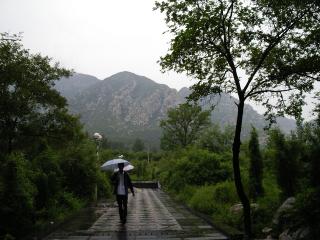
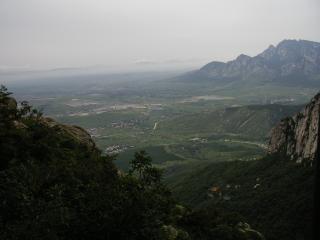
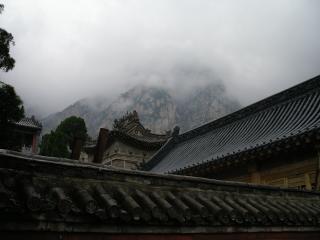
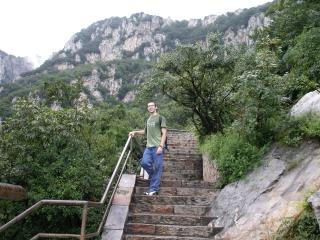
I climbed Song Shan (a nearby mountain) this past Saturday, by myself until I was more-or-less adopted by a trio of middle-school boys. We hiked together, in so much as we went at different paces, looked at different things and barely talked to each other. We did, however, summit the mountain together, and at the other end, reach the parking lot together; there was a vague sort of comraderie that helped us keep going through the sort-of-difficult times as we all realized that it was somewhat-too-cold for tee shirts at the top of the mountain. With a sweeping gesture of my metaphorical wand, I will reveal to you how this climb was a microcosm (is that a kind of molehill?) of my overall experiance here, thus far. But first, pictures:

Liminal is a favorite word of the overeducated and underemployed everywhere, and for good reason. It refers to the between-places and states of being that exist at the margins of all of our activities. Commuting, for example, is a somewhat liminal experiance, in that it is not generally an activity that is sought out for itself. If you're driving for fun, it's called going for a drive, not going for a commute. When you are commuting, you are not at work, but you aren't really not at work either, you're going to work or coming from work.
Which is not to say that there are not a whole slew of activities and even livelyhoods that spring out of this liminal state in which most people exist for more than an hour every day. People listen to the radio, read the newspaper, some even get work done. Which are interestingly cyclical propositions if you think about it, because the radio personalities you listen to work so that you can experiance their product while you are becoming at work; likewise with the newspaper publishers and the laptop designers and such. Which means that they have commutes when they are not at work, and so on...
If I'm getting to a point, it is this: many writers view pilgrimages and the like as a sort of sought-out and extended liminal experiance. In a certain sense, you take a short pilgramage every time you take agency during your commute to, for instance, appreciate the train station as a place rather than suspending agency while you pass through it. Still other writers have posited that the Wanderjahr, taken by so many young people is, even in being so named, a form of pilgrimage, a trip into the liminal.
In the Chinese tradition, the classical form of removal from society to the fringe of civilization it that of the xian (pronounced sheean) or trancendi. The immortals who remove themselves to the mountains and subsist on wind and dew. The character for xian is in fact a combination of the radicals for man and mountain (perhaps more complex than that historically, etc, etc, hooray Prof. Berkawitz). Regardless, the mountains remain one of the places to which the Chinese (among others) like to escape temporarily from the hustle and bustle. They are the primary sites of pilgrimage.
And, bringing this stray topic to the center of my discourse, I reveal that: the very Song Shan I climbed is one of, perhaps the most sacred of Chinese mountians. Song Shan is the axis of the five sacred Daoist mountains; it represets Earth, the central of the five phases (elements) of matter in Chinese philosphy (the other four are metal, water, wood, fire [and again earth, metal...]). So just as the three youthes were fellow pilgrams, so too are my acquantainces here at Shengda fellow travelers. While we share a road and a sort of compainionship, it seems as if we are all (or at least as if I am) waiting for the moment when our paths diverge. Climbing a holy mountain was merely a pilgrimage within my greater pilgrimage. Pretty deep, enh?
Business:
I can't access the blog itself from China, only the applet to post to the blog. As such, I can't get to your comments (if there are any). I also don't know if the pictures are posting properly, so it'd be great if someone drops me an email to let me know.
And for Dana, if she's reading:
Social mountaineering, in Chinese: xiang shang pa (pronounced sheeang shang pa, a's like the o in pot). It's almost dead on, litterally "facing (intending) to climb higher," usage as "seeking social advancement."


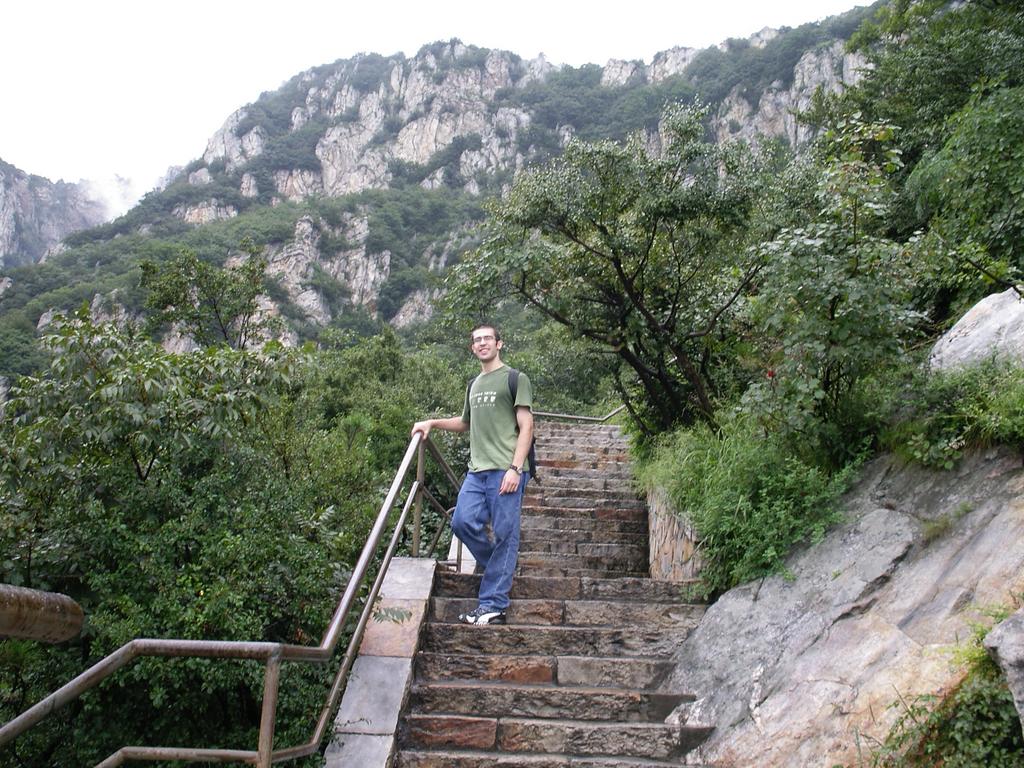
Liminal is a favorite word of the overeducated and underemployed everywhere, and for good reason. It refers to the between-places and states of being that exist at the margins of all of our activities. Commuting, for example, is a somewhat liminal experiance, in that it is not generally an activity that is sought out for itself. If you're driving for fun, it's called going for a drive, not going for a commute. When you are commuting, you are not at work, but you aren't really not at work either, you're going to work or coming from work.
Which is not to say that there are not a whole slew of activities and even livelyhoods that spring out of this liminal state in which most people exist for more than an hour every day. People listen to the radio, read the newspaper, some even get work done. Which are interestingly cyclical propositions if you think about it, because the radio personalities you listen to work so that you can experiance their product while you are becoming at work; likewise with the newspaper publishers and the laptop designers and such. Which means that they have commutes when they are not at work, and so on...
If I'm getting to a point, it is this: many writers view pilgrimages and the like as a sort of sought-out and extended liminal experiance. In a certain sense, you take a short pilgramage every time you take agency during your commute to, for instance, appreciate the train station as a place rather than suspending agency while you pass through it. Still other writers have posited that the Wanderjahr, taken by so many young people is, even in being so named, a form of pilgrimage, a trip into the liminal.
In the Chinese tradition, the classical form of removal from society to the fringe of civilization it that of the xian (pronounced sheean) or trancendi. The immortals who remove themselves to the mountains and subsist on wind and dew. The character for xian is in fact a combination of the radicals for man and mountain (perhaps more complex than that historically, etc, etc, hooray Prof. Berkawitz). Regardless, the mountains remain one of the places to which the Chinese (among others) like to escape temporarily from the hustle and bustle. They are the primary sites of pilgrimage.
And, bringing this stray topic to the center of my discourse, I reveal that: the very Song Shan I climbed is one of, perhaps the most sacred of Chinese mountians. Song Shan is the axis of the five sacred Daoist mountains; it represets Earth, the central of the five phases (elements) of matter in Chinese philosphy (the other four are metal, water, wood, fire [and again earth, metal...]). So just as the three youthes were fellow pilgrams, so too are my acquantainces here at Shengda fellow travelers. While we share a road and a sort of compainionship, it seems as if we are all (or at least as if I am) waiting for the moment when our paths diverge. Climbing a holy mountain was merely a pilgrimage within my greater pilgrimage. Pretty deep, enh?
Business:
I can't access the blog itself from China, only the applet to post to the blog. As such, I can't get to your comments (if there are any). I also don't know if the pictures are posting properly, so it'd be great if someone drops me an email to let me know.
And for Dana, if she's reading:
Social mountaineering, in Chinese: xiang shang pa (pronounced sheeang shang pa, a's like the o in pot). It's almost dead on, litterally "facing (intending) to climb higher," usage as "seeking social advancement."
Tuesday, August 16
Shengda
In liu of a pseudointellectual rant (at least for the time being), a campus tour:
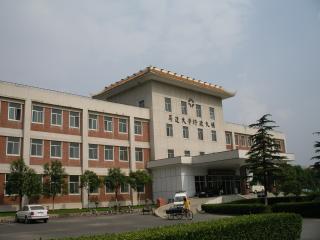 The administration building
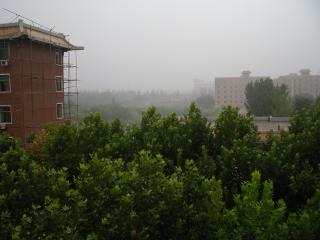 The view from my balcony
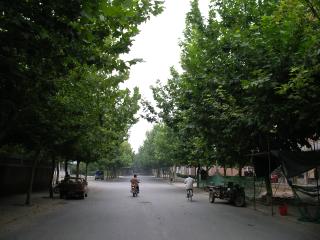 A road through Campus
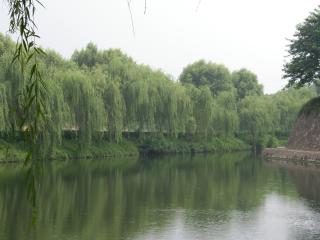 The artificial lake
 Construction just outside the door to the foreign expert building
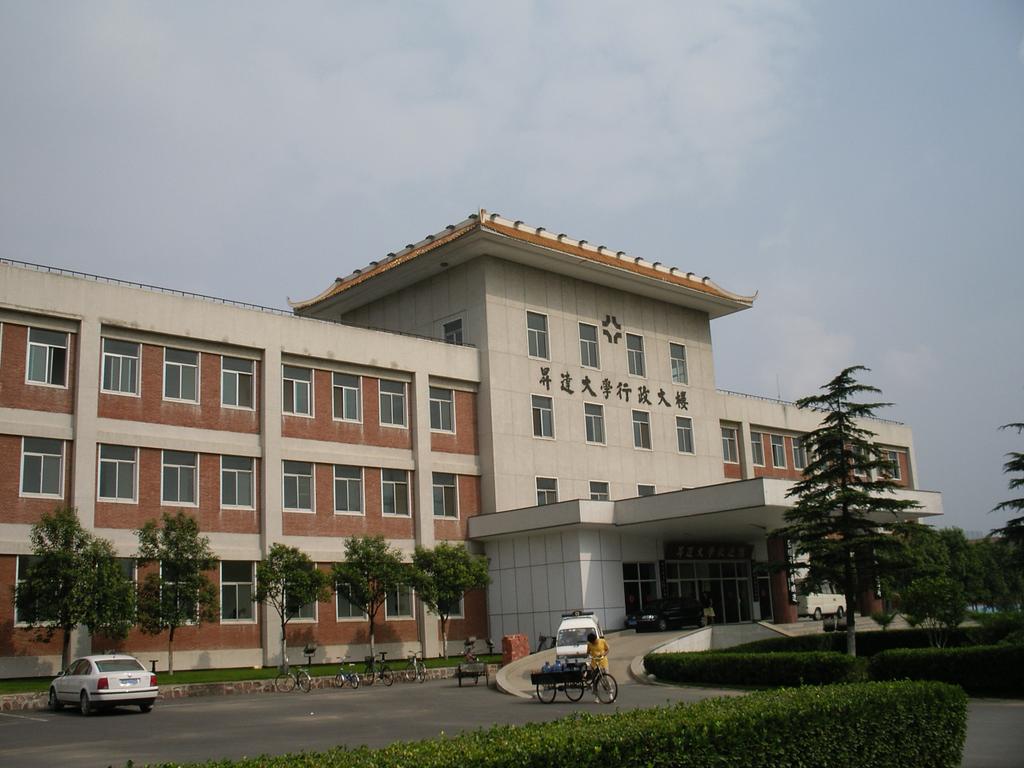 The administration building
 The view from my balcony
 A road through Campus
 The artificial lake
 Construction just outside the door to the foreign expert building
Friday, August 5
Waiting
Waiting seems to be the central activity of my life right now. I'm leaving for China on Wednesday, and the bulk of my errands and preparations are finished, all that is left is to go...five days from now. There is something about this time that seems interminably long, just as six days, seven days and two weeks were before it. I've more or less spent the entire summer waiting. And before that there was senior week, which was basically just waiting to graduate.
Now the fact is that I've done plenty of things during this time of waiting. I've been back and forth between Philadelphia and Princeton what seems like innumerable times, and to Washington DC once, but this feels more like pacing writ large than like any sort of real journey or activity. I even got stuck waiting for an extra two days in DC while my car was repaired after an attemted theft. A theft which the police tried to pin on my friend Aongus because he looked suspicious waiting on Erin and Sarah's porch all day. As fun as all this waiting could be at times, hanging out with friends, going to museums and the Fourth of July celebration on the National Mall (where I missed the fireworks waiting in line for the portapotties), it was nevertheless waiting. All these encounters seemed like the extended cut of running into a friend at the train station.
And when I think about it, all this waiting is just in preparation for more waiting. Traveling in the modern era seems more like waiting to be somewhere else than any particular process of moving. Waiting at the airport is almost down to an science: they make you wait in lines to get permission to wait in other lines. And then you get to your gate and wait to board, board and wait to take off, take off and wait for drink service, wait for the inflight movie to begin and - upon realizing that the inflight movie is horrific - wait for the inflight movie to end. The rest of the flight is basically waiting to land, whereupon you wait to disembark, wait for your luggage, wait for a ride, wait in traffic - all the time glancing at your watch - the adult version of "are we there yet?"
I suppose this can all be put down to a fact of life. Regardless, I am forced to appologise because I will soon need to keep you waiting, although I am sure it is not with baited breath.
China is next.
Apres ça, la deluge
Now the fact is that I've done plenty of things during this time of waiting. I've been back and forth between Philadelphia and Princeton what seems like innumerable times, and to Washington DC once, but this feels more like pacing writ large than like any sort of real journey or activity. I even got stuck waiting for an extra two days in DC while my car was repaired after an attemted theft. A theft which the police tried to pin on my friend Aongus because he looked suspicious waiting on Erin and Sarah's porch all day. As fun as all this waiting could be at times, hanging out with friends, going to museums and the Fourth of July celebration on the National Mall (where I missed the fireworks waiting in line for the portapotties), it was nevertheless waiting. All these encounters seemed like the extended cut of running into a friend at the train station.
And when I think about it, all this waiting is just in preparation for more waiting. Traveling in the modern era seems more like waiting to be somewhere else than any particular process of moving. Waiting at the airport is almost down to an science: they make you wait in lines to get permission to wait in other lines. And then you get to your gate and wait to board, board and wait to take off, take off and wait for drink service, wait for the inflight movie to begin and - upon realizing that the inflight movie is horrific - wait for the inflight movie to end. The rest of the flight is basically waiting to land, whereupon you wait to disembark, wait for your luggage, wait for a ride, wait in traffic - all the time glancing at your watch - the adult version of "are we there yet?"
I suppose this can all be put down to a fact of life. Regardless, I am forced to appologise because I will soon need to keep you waiting, although I am sure it is not with baited breath.
China is next.
Apres ça, la deluge
Subscribe to:
Posts (Atom)